Tuesday, November 13, 2012

Rehoboth Beach Independent Film Festival


Robin and I attended our first RBIFF in 2002, and were looking forward to this year’s event which marked its fifteenth year.  RBIFF has grown considerably over the years.  Last year more than 19,000 individual movie tickets were sold during the festival’s five days. 

RBIFF usually begins on Wednesday of the second week of November and continues through the following Sunday.  This year’s program included more than 55 independently  produced feature and documentary films from the U.S. and elsewhere as well as a substantial number of short films.  Our list of ten films included three from Italy, two from the U.S. and one each from Argentina, Israel, India, Kazakstan and South Africa.

What makes the RBIFF special is that all of the films are screened at the Midway Movie complex on Route 1.  A large tent is set up behind the theaters for film-goers to buy tickets, eat, drink, chat and relax between films.  This is different from most urban film festivals where screenings are held at  a number of different venues throughout the city, and it is unlikely that one will see the same people from film to film.  

At  RBIFF, everyone comes to this one event and keeps coming back until it is over. Some attendees will see more four films each day. Lines begin to form inside about 30 minutes before every film, and most people are amenable to talking about about what one has seen, what was good or bad  or indecipherable.  It’s all about the films, and the conversations Robin and I have with others add immensely to our enjoyment of the festival.  

We had two favorites this year. the first was “Lucky,” where a 10-year old South African boy  leaves his village after his mother dies of AIDs to live with his troubled uncle in a Durban apartment complex.  Lucky encounters an elderly Indian woman, with a deep fear of black South Africans, who lives in the same complex. Their relationship grows  through a series of harrowing incidents even though he does not understand English and she cannot speak his native language. Wonderfully acted by the two protagonists, their ability to understand each other and change grows despite the fact that they cannot talk to  each other.

Our other favorite was a documentary, “Searching for Sugar Man,” the story of Sixto Rodriguez, a rock musician of the early 70s, who never made it in the U.S. but became a tremendous success in South Africa.  Two South African fans undertake to learn what happened to Rodriguez and all of the profits from his albums.  The film has terrific music, of course, and takes some very unusual twist and turns.

RBIFF did not disappoint in 2012, and we are looking forward to next year.


Thursday, November 1, 2012

Hudson Valley


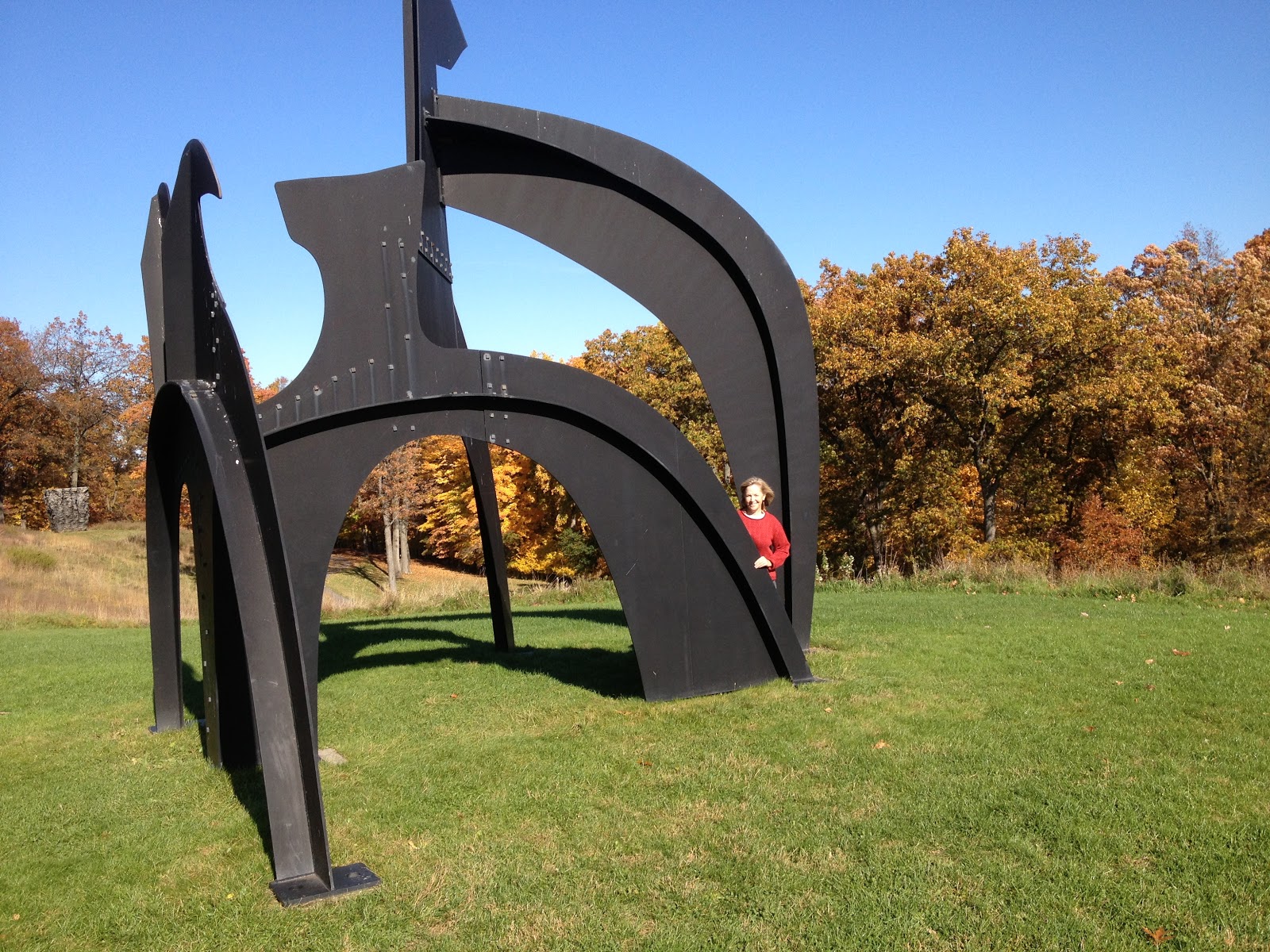
Robin and I have wanted to explore the Hudson Valley for some time, and we finally made plans for the week of October 22.  Poughkeepsie, NY was to be our base of operations for the first two days, and we left early Monday morning having targeted the Storm King Art Center as our first stop.  Near Newburgh, NY, the Storm King Art Center displays large sculpture in an outdoor setting of more than 500 acres with meadows and rolling hills. The day was beautiful, we were fortunate that the autumn colors were still there.  We delighted in sculpture by Calder, Moore, Noguchi, Nevelson, and so many others.  Large abstract forms were viewed first from a distance and then close up.  We had never visited a museum of this kind.


It was a short drive to our Poughkeepsie hotel, and we had dinner at an excellent restaurant on Main Street, the “Artist’s Palate.”  On Tuesday the rains began, so we decided to drive north for three miles to visit Hyde Park, the home of FDR.  This is not a mansion like so many of the great estates along the Hudson, but rather a home lived in by a very well-to-do family.  No great reception halls or state dining rooms here, rather comfortable living quarters which were visited from time to time by famous historic figures like Churchill and King George VI of England.  The National Park Service tour is excellent, and we learned many factoids such as the way the staff folded Roosevelt’s legs, removed his braces, and scuffed his shoes when visitors came, to give the impression that he could walk.

For fun we decided to have lunch at the Culinary Institute of America (“CIA”), which was just up the road.  The CIA now has four campuses - Poughkeepsie, Napa Valley, San Antonio and (this year) Singapore.  Here in New York, the CIA has about 3,000 students on campus, all dressed in their checked  pants and white chef-shirts and deeply engrossed in all aspects of food.  They are the chefs for the four CIA restaurants as well as the staff, and one feels the energy and enthusiasm of the students.  The food may sometimes be “off,” but the setting more than compensates.  

Our lunch was at the Apple Pie Bakery Cafe, where we waited in line with others to select items from a menu and a display case of beautifully baked goods.   After our order was taken, we were given a number to be placed on a stand on our table, and waited for the food to be delivered.  Robin’s quiche had a superb crust, but her salad had a vinaigrette without soul (and too much salt).  My turkey sandwich was so cold I needed gloves to hold it.  But wait a minute!! - the desserts.  Robin had the “not an Oreo” which was chocolate sablee pastry crust with white chocolate ganache, and I ordered the lemon merengue tart, which had lemon curd and vanilla pastry cream with a caramelized italian merengue inside a crisp almond tart shell.   Sublime!!  We checked out the Vanderbilt mansion up the road, and then nap time beckoned.


Wednesday we headed north to Bard College to see the Fisher Center for the Performing Arts designed by Frank Gehry.  We were surprised by the very large and beautiful college campus with low-slung buildings surrounded by tall trees.  Gehry has designed a dramatic building from the outside, with large flowing pieces of metal that seem about to move - and then a well-designed concert hall on the inside.  Our next stop was Olana, the home of Frederic Church, one of the major figures in the Hudson River Landscape School of painting, known for the light which emanates from the interior of his paintings.  He designed his home after a trip to the Middle East, and it is an eclectic structure with a strong Persian influence.  Olana is perched on a hill overlooking the Hudson River, and its 300 acres are filled with ponds, trees planted by Church, and walking paths, which he designed as well, that meander through this beautiful  property.

Next, we headed for the town of Hudson, NY, which is rapidly becoming the restaurant capital of the Hudson Valley.  Warren Street has a great many choices, and we selected Cafe Le Perche for its charm, salads and baked goods.  We returned to Rhinebeck, NY where we stayed in the main building at the Beekman Arms, which has been around since 1766.  They claim to be the oldest continuously-operated inn in the United States. 


Dinner that evening was at Escoffier, the top restaurant at the CIA.  Our reservation was for 6:30, and Escoffier has been moved to the St. Andrews building, as its former space is being transformed into a new restaurant to be called “Bocuse.”  Sadly, Escoffier will now only be the name of a  dormitory at the CIA.  As at Apple Pie, the staff was charming and energetic but only moderately skilled and barely knowledgable, such that they had to revert to the two senior maitre d’s for answers to our questions.  Our Kir Royales were the best ever.  The sommelier recommended that I try a glass of sauterne with my pate de fois gras, which was a brilliant suggestion to replace the “champagne goes with everything” response one usually gets.  Robin’s green bean salad was fine, but my braised lamb shoulder in a ginger-carrot puree was over-salted, and Robin’s filet of beef was more well than medium.  However, our friendly sommelier came through again by recommending a glass of Chateaux Trintaudon (2006) which went perfectly with our food.  For dessert, Robin’s tarte tatin was a big lump of baked apple rather than thinly sliced while my pot de creme was so densely chocolate that it consumed my chocolate quota for the next three days.

Our final day was reserved for Dia Beacon, an art museum in a former Nabisco box factory, which overlooks the Hudson River at the town of Beacon, across the river from Newburgh.  The town has been given new life both by the museum itself but also because of a local developer who acquired most of the west end of town and has attracted many small shop owners and new restaurants to the area.   The museum itself is composed of many large spaces with installations of very different post-modern art.  There are wall installations by Sol Lewitt, one of which is composed of 24 squares with interior lines in varying mathematical compositions, repeating but NOT repeating.  Another artist dropped thin lines of thread from the ceiling which give the illusion that they are lucite frames.  (There is even a sign which says “Please don’t lean on the art.”)Also, there are huge dramatic steel installations by Richard Serra.  All of it is so impressive and challenges the expectations of the museum goer.

Our trip concluded with a family visit to Sharon CT, and we were back in DC Friday evening preparing for Sandy.


Tuesday, August 14, 2012

Rangeley, Maine


I first visited Rangeley, Maine in 1970 at the suggestion of a friend, whose description of large lakes and 3,500 foot mountains reminded me of the Adirondaks where I had gone to camp for many years.  Rangeley is in the northwestern corner of Maine, 50 miles from New Hampshire and 75 miles from Canada, a bit too far for spontaneous travel and gentrification.  So a 1945 picture post card of Main Street looks much the same as today’s Main Street, but with modern automobiles.For me, time stops when I arrive at Rangeley, and memories are vivid. Robin and I have been here together at least seven times since 1987 - alone and together with family and friends.  We always stay at North Camps, a group of twelve very rustic cabins and a main lodge, which have been owned by the Gibson family since the early fifties.  In 1970, Gibby ran the place; and then Sonny (his son, of course) took over in the eighties. Now Gibby’s grandsons, Glen and Fran, are running the place under their father’s careful supervision.


The cabins are nestled among birch and pine trees along 300 feet of shoreline on the north side of Rangeley Lake, which is 12 miles long and 5 miles wide. 


There are the usual amenities - a modest beach, docks, motor boats, canoes, and kayaks and a 40-year old sunfish.  Especially attractive is the centrally located dirt tennis court, which measures differently in length to the serving line from the net on one side from the other and has retaining fences about three steps too close to the serving line - all making for an extra challenge while playing.

This is where my sons learned to play chess and to water ski, where we got lost on the Appalachian Trail looking for Piazza Rock, and where my friend Steve Schwartz and I had ferociously competitive tennis matches.  (I always made sure to win our very last match on Saturday as new people were arriving and stopped to watch the competition.)

Rangeley Lake is connected to five other large lakes, making for a wonderful week-long canoe trip if you are so inclined.  Hiking trails are everywhere, and the vistas are extraordinary.  Saddleback Mountain, at the east end of the lake, has been developed as a family ski resort.  The guests at North Camps are self-selecting and repeaters.  We reinforce each others’ decision in coming to Rangeley by relating our similar experiences and shared memories.

“So what do you do at Rangeley?,” someone might ask.  “It is a very busy time,“ I answer, because there are so many old bases to touch while exploring the new.

  • first swim in the lake
  • schmooze with Sonny
  • Red Onion restaurant for pizza

  • shop for food at the IGA
  • decision whether to run the Mingo Loop (6.3 miles)
  • see your first moose
  • ice cream at the Pine Tree Frosty

  • visit the Chamber of Commerce to find out the weekly doings
  • twin lobster night in the town of Oquossoc
  • see what is new at the Alpine Shop
  • visit Small’s Falls
  • more ice cream at the Gingerbread House
  • select hikes for the week

  • canoe the Androscoggin River

This year for the first time we learned about a wonderful book, We Took To The Woods, by Louise Dickinson Rich, an autobiographical account of a young woman from the suburbs of Boston who fell in love with a Maine woodsman, whom she met on a summer vacation.  She tells how they married and lived together in the woods, not far from Rangeley. The book was first published in 1942, and is skillfully written.  Each chapter answers a question which might have been asked by an urban friend.  “Don’t you ever get bored?”  “How do you make a living?”  “ Why don’t you write a book?”

This was our newest Rangeley discovery; can’t wait for the next visit.

Monday, August 13, 2012

Too Many Beeps


Is it the refrigerator? Door left ajar.

Is it the alarm system? Low battery.

Is it the washing machine? Laundry ready.

Is it the timer? Dinner ready.

Is it the smoke detector? Need a new battery.

Is it the alarm?  Time to wake up.

Is it the car alarm? Someone out there.

Is it my computer? New email.

Is it my cell phone? New text?

Is it my imagination?????

Tuesday, July 31, 2012

Parking Lot Dilemma


Robin and I went to the Avalon Theater to see the “The Dark Knight Rises,” and we parked in the lot behind the local branch of the DC Library between McKinley and Patterson Streets.  The lot is narrow with perpendicular parking, a lane for cars and a fire lane which is often lined with parked cars.
As we were leaving the lot, but just before we reached the Patterson Street sidewalk, an older (meaning older than I am) Virginia driver and his wife tried to enter the parking area and drove across the sidewalk.  The fire lane was blocked  by a parked car, so there was no room for two cars to pass. When I motioned to him to back up so that we could leave, he refused to budge and shook his head with a vehement “no.”  
WHAT WOULD YOU  HAVE DONE?
  1. Back up and allow him to enter the lot?
  2. Shake your head with a vehement “no” and refuse to move?
  3. Make a show of writing down his license plate and indicating that you are calling the police?
  4. Get out of the car, lock the doors and walk away?
  5. Another non-violent option?

Tuesday, July 17, 2012

The Perfect BLT


On a 100 degree day in Washington what better way to say “summer” than to make a BLT with fresh, hand picked ingredients.  Our Rock Creek garden is finally producing the  heirloom tomatoes we carefully selected in the spring.  I picked up some thick cut, maple wood smoked bacon at the supermarket, and Robin secured a bunch of fresh romaine lettuce.
All we needed was the delivery system. We decided to abandon our traditional Arnold white bread, which had been specifically chosen for its blandness so as not to distract from the flavors of the key ingredients.  A seeded Jewish rye bread from Newark, New Jersey caught our eye, and we ventured into new territory.
The sandwich bread was toasted, slathered with Hellman’s and completed with our bacon, lettuce and tomatoes.  The rye bread added an exciting density and flavor to our other components.
Happy Summer!

Sunday, July 15, 2012

Summer Sailing in the Caribbean


I have spent very little time in the Caribbean - a few business trips here and there but never a vacation.  So when my racquetball buddy, Joe, asked me in January if I wanted to join him the first week in July on a friend’s 42 foot catamaran based in Martinique, I jumped at the chance.
Would the waters really be the aquamarine blue color one sees in magazine advertisements? Would the trade winds from the East be constant?  Would I spend more time trying to keep afloat while snorkeling than seeing beautifully colored fish swimming between the rocks and coral?
Joe’s friend had purchased his Lagoon 420 three years ago, making a down payment of a portion of the purchase price with the remainder financed under an agreement to allow the boat to be chartered for five years.  Under the deal, the owner is allowed two weeks of “owner’s time” in July - usually too early for the hurricane season in this part of the Caribbean.
We all met in early June at the owner’s home to agree on a list of provisions for the trip, which would be supplied by the charter company, Sparkling Charters.  Since it was a French company, Sparkling Charters gave us a three page list of wine, beer, and      hors d’oeurves before we got to mundane things like cereal, peanut butter and spaghetti. 
We flew from Baltimore to Miami and then on to Fort de France, the capital of Martinique.  A forty-five minute cab ride took us to Le Marin, a small coastal town to the East where Sparkling and other charterers had their boats in slips at a large marina.  It was quite a sight to see so many million dollar sailboats in one place.  Preparations for departure are lengthy.  We had to check that our provisions were correct, confirm the various boating equipment and other items placed on board by Sparkling Charters, and finally check in with customs using an antiquated system previously on paper and now on a very slow computer.


Once under way, daily rhythms begin to change in so many ways.  The movement of the boat is very different from walking on land, so very quickly one becomes conscious of balance and  hand holds. The wind, or lack thereof, is very important, and the options for choosing shade or sun are limited on a boat.  Changes in sky are noticed immediately.  Are the clouds building to the East?  How long before it will rain?   How different it is for us at home where rolling seas are not an issue; winds are not a concern; air conditioning is available; and rain gear is an option if we choose to go outside in threatening weather.
On a clear day one can see St. Lucia from Martinique, a distance of about twenty miles. However, on both of our passages to and from St. Lucia it was hazy, so that after an hour, we thought we were in the open ocean.  Heading south from Martinique the wind was at our back and the sea was relatively calm with waves of 2-3 feet.  On the return trip it was quite different with the wind heading into us and rough seas.


While in St. Lucia, we selected a different harbor each night.  Rodney Bay was a broad crescent with Pigeon Island at one end and hotels and sand beaches at the other.  The inner (protected) portion of the harbor was filled with luxurious sailboats and was bordered on one side by expensive private homes.   Marigot Bay was a deep sliver, a perfect “hurricane hole” with beautifully designed homes on the hillsides and one of the home bases for another large charter company, Moorings.  Our final harbor was at the town of Soufriere, also the home of Gros Piton and Petit Piton, two very impressive volcanic mountains at the south end of the Bay.


At our various stops, we hiked, snorkeled, visited botanical gardens, swam in warm sulfur springs, and tasted the some of the best local rum.  The weather was very pleasant - around 85 degrees and usually with a good breeze.  Evening were cooler and it rained for an hour or so every night around 2:00 a.m.
As with every adventure, things can happen.  Our dingy motor was very uncertain and finally stopped operating at the very end of the trip.  Two days before returning to Martinique, the main halyard snapped as we were raising the mainsail.  Our refrigerators were very unpredictable when it came to making ice, creating great anxiety as to whether would would have our rum and coke at cocktail time.
I am beginning to think that we should block out some Caribbean sailing time for July 2013.